How a Human League album became an argument about where performance ends and production begins
By the time Martin Rushent started work with The Human League in late 1980, the Sheffield group had already shed half its membership — Philip Oakey and two recruits with almost no studio experience facing a Virgin Records deadline. What arrived at Rushent's Genetic Sound studio in Berkshire was less a functioning band than a collection of parts: synthesizer sequences, lyric fragments, a drum machine. Rushent's contribution was to work out how those parts could constitute a record.
His tools were specific. The rhythm foundation on Dare (1981) came primarily from a Linn LM-1, its characteristic low-end kick and hi-hat patterns sitting underneath arrangements built from synthesizers sequenced in lock-step with tape. The sync problem — keeping a step sequencer running in exact time with a multitrack — was not trivial, and Rushent's facility with it was central to the record's coherence. Solving that alignment was the unglamorous prerequisite for everything else.
The synths were largely Roland — several models among them — with patches programmed and stored so they could be recalled across sessions. This was the practical value of patch memory at the time: a sound could be rebuilt the next day, which meant the record could be assembled incrementally rather than captured in a single live take. The arrangement of "Don't You Want Me" is a demonstration of that method. Its layers arrive and depart with an architectural precision that is not accidental; it is designed.
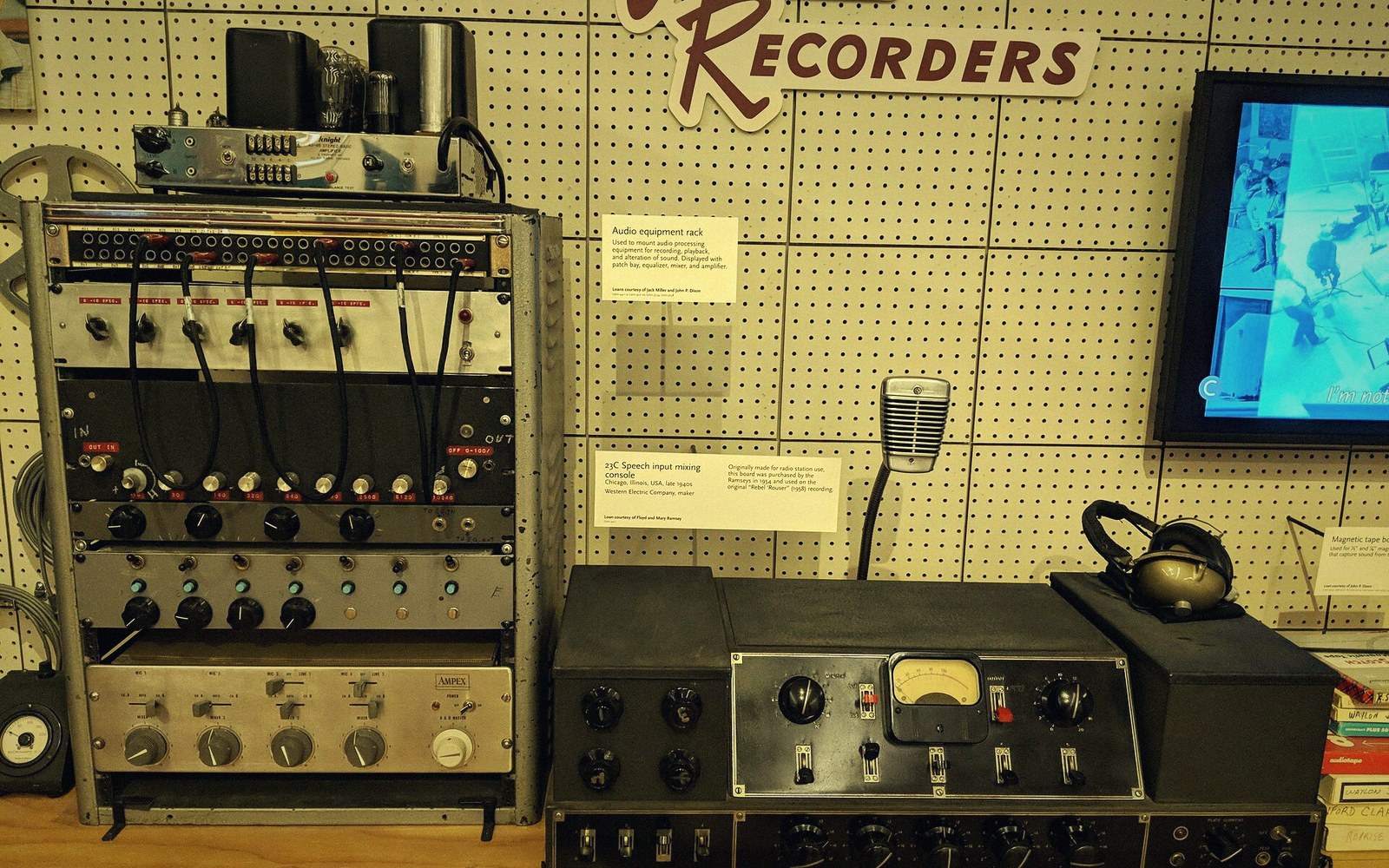
Photo: Western Electric 23C Speech input mixing console (1940s) purchased by Floyd Ramsey at Audio Recorders (studio) in 1954, & unknown recording studio rack - MIM Phoenix AZ (2017-12-04 14.04.59 by bobintraveling 140459) · Wikimedia Commons
Editing as Composition
What made Dare unusual was how much of it was constructed in the editing stage rather than performed in the traditional sense. Rushent worked on a 24-track machine, which gave him the track count to isolate elements — a bassline here, a keyboard pad there — and treat them independently in the mix. Sections were dropped in and out, transitions were built from assembled fragments rather than played through, and the final sequence was partly a product of the cutting room.
This places the album squarely in the territory where the producer as author becomes the honest framing. Rushent did not merely balance and EQ a performance; he made structural decisions about what the record would be. The question of whether Oakey's vocal or Rushent's sequencer lock is the primary event on any given track is, genuinely, hard to answer — and that ambiguity is productive rather than evasive.
The Human League's own account emphasises Oakey's songwriting; Rushent's account, where it exists in documented interviews, emphasises the degree to which the studio was the instrument. Both are accurate. The record is the result of both things being true simultaneously, which is exactly what makes it a useful case study.
What the Room Did and Didn't Do
Genetic Sound was a private facility — Rushent had built it specifically to work this way, outside the economics of commercial studio hire. That freedom mattered. The record was made iteratively, with the band returning across months to add and revise, and that timeline would have been prohibitive in a facility billing by the hour.
The studio's character is relatively dry; Dare is not a record defined by room ambience in the way that, say, the Townhouse stone room defined the Phil Collins sound of the same period. The space is absent in the mix, which suits the machine-made aesthetic: there is nothing warm or accidental about the sound, and that is the point.
The Human League's own account emphasises Oakey's songwriting; Rushent's account, where it exists in documented interviews, emphasises the degree to which the studio was the instrument.
The programmed kick drum on "Love Action" sits in a pocket created partly by what is not around it — no live room spill, no bleed, no organic decay. Everything that sounds like it could be turned off individually was, in fact, programmed to be turned off individually. This is production as architecture rather than production as capture.
Dare reached number one in the UK, and its success made Rushent's method — sequencer-first, edit-heavy, studio-as-compositional-space — legible to a generation of producers who followed. The record did not invent any of the individual techniques it used, but it applied them with enough coherence and commercial result that it functioned as a proof of concept. The argument it makes about where performance ends is still running.
Continue in The Desk
Same section, next entry
Related elsewhere in the magazine
Named in this entry
Every name above is real and appears here for documented work only. Where an origin story is contested this magazine says so rather than choosing the tidy version.