The Machines / Entry 1.1
The TR-808
A machine that failed on its own terms and succeeded on everyone else's
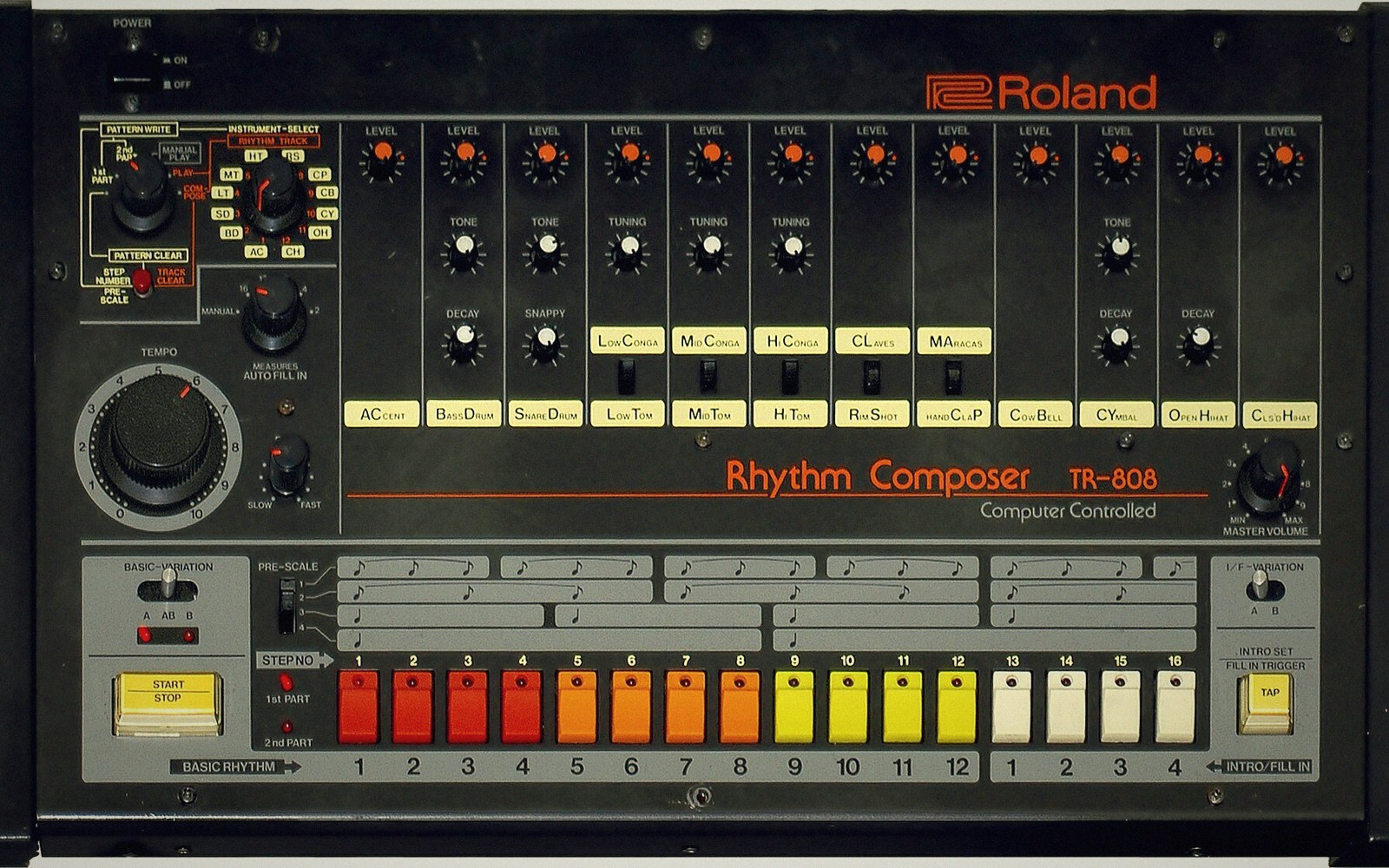
Roland's Rhythm Composer TR-808 shipped in 1980, cost around $1,195, and was discontinued by 1983. By every measure Roland intended, it was a disappointment: it was supposed to sound like a drum kit, and it did not. The bass drum boomed with a low, almost subsonic weight that no acoustic kick had ever produced. The snare was a fizzing burst of white noise over a short tone.
The hi-hats — open and closed — were metallic and thin in a way that unsettled rather than convinced. Roland soon moved on. What they moved on to was the TR-909, which was closer to real. What they left behind was the 808.
The reason it survived, and eventually dominated, is that a small number of producers in Chicago, New York, Atlanta and beyond heard those synthetic textures not as failures but as materials. The 808 was cheap on the secondhand market through the mid-1980s — precisely because it sounded wrong — and it was programmable in a way that invited use as a compositional tool rather than a stand-in for a session drummer.
How the machine actually worked
The TR-808 is an analogue drum machine. Every sound it makes is synthesised on the fly from analogue circuits: tone generators, noise generators, envelope shapers and filters, one for each instrument voice. There is no sampling involved — no recorded audio stored inside the chip.
The bass drum is produced by a bridged-T oscillator whose pitch sweeps rapidly downward on each hit; the decay time is adjustable, and running it long produces that characteristic low rumble that sits as much in the body as in the ear. The snare combines a noise burst with a short resonant tone.
The toms are pitched oscillators; the cymbals are generated by a network of square-wave oscillators running at slightly mismatched high frequencies, creating a harsh metallic shimmer that approximates — but never truly sounds like — brass.
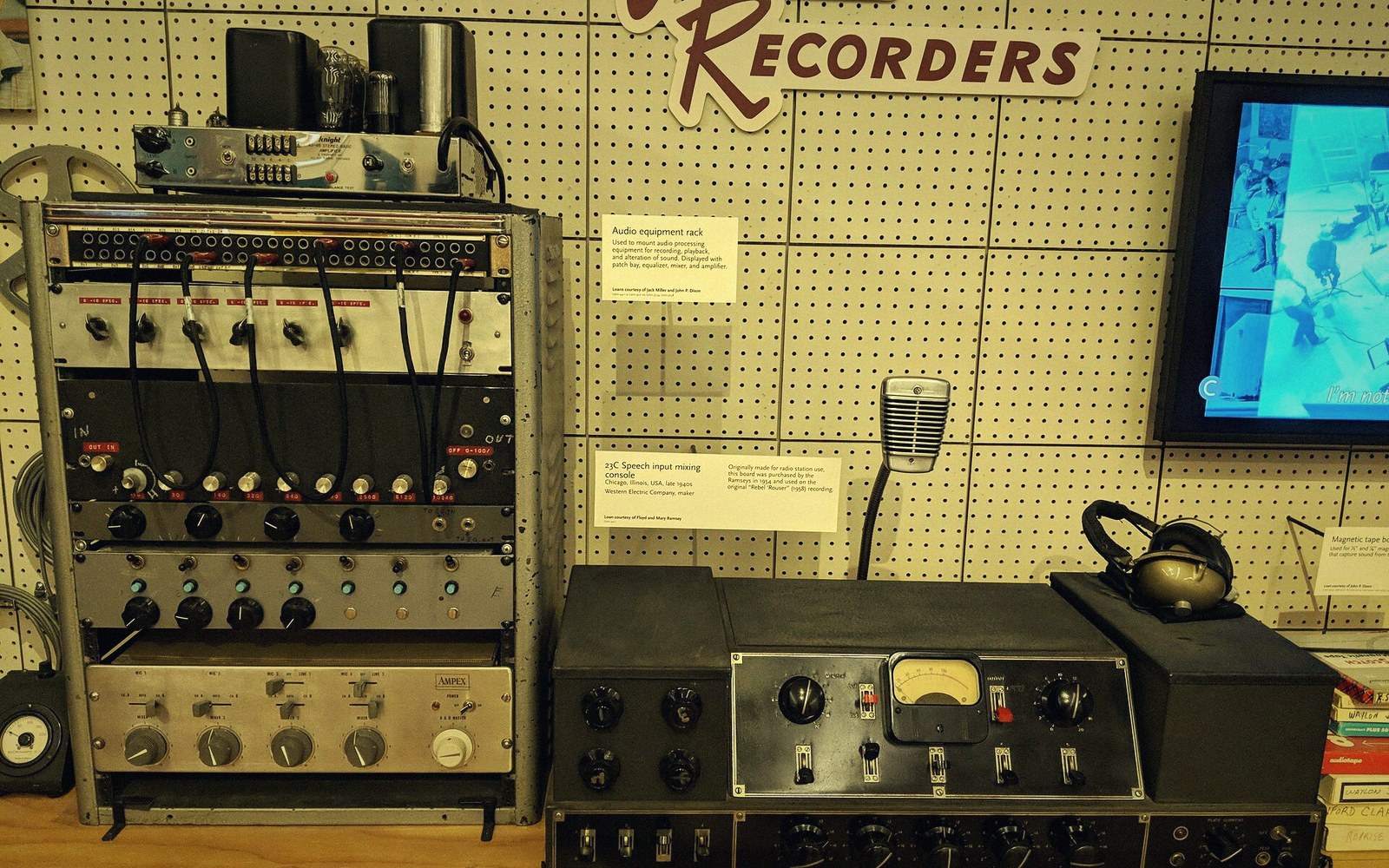
Photo: Western Electric 23C Speech input mixing console (1940s) purchased by Floyd Ramsey at Audio Recorders (studio) in 1954, & unknown recording studio rack - MIM Phoenix AZ (2017-12-04 14.04.59 by bobintraveling 140459) · Wikimedia Commons
Programming a pattern on the 808 uses a step sequencer built into the front panel: sixteen buttons across the top of the machine, each representing a sixteenth-note position in a bar. You select an instrument, light up the steps where you want it to hit, and play. The tempo is set by a dial.
You chain patterns together to build longer structures. What this workflow produces, for a working musician or producer, is a grid-locked, metronomically perfect rhythmic loop — something a human drummer cannot replicate, and which the 808 makes no attempt to disguise.
The machine also has accent and shuffle controls. Accent allows individual steps to hit harder, shifting the feel. The shuffle — labelled "swing" on later Roland machines — imposes a slight timing offset on alternate sixteenth notes, nudging what would otherwise be mechanical rigidity toward something more humanly weighted. These controls are part of why the 808 acquired expressive range beyond what its basic architecture suggests.
One more feature mattered enormously in practice: the individual audio outputs. As well as a mono mix, the 808 provides separate outs for the bass drum, snare and other voices.
This allowed each drum sound to be routed to its own channel on a mixing desk and processed independently — compressed, EQ'd, sent through a reverb unit, or given the gated reverb treatment that defined much of the drum sound of the early 1980s. The 808 was, in this respect, a multi-instrument source, not a single monolithic sound.
Adoption, accident and genre formation
Afrika Bambaataa and Arthur Baker used the 808 as the rhythmic engine of "Planet Rock" in 1982, pairing it with a Kraftwerk-derived melodic line and releasing it on Tommy Boy Records. The record did not use the 808 to approximate anything acoustic: it used it for exactly what it was, an analogue synthesiser that happened to be shaped like percussion.
The bass drum on "Planet Rock" is a sound with its own physical character, distinct from any kit. That decision — to stop apologising for the machine's synthetic nature and instead compose around it — opened the template.
In Chicago, the 808 moved into the architecture of house music through producers working at the Music Box and at home, recording straight to tape and distributing on twelve-inch singles through local record pools. The bass drum's long decay filled the low end of a mix at a frequency that subwoofer-equipped club systems could reproduce with visceral effect.
Programming a pattern on the 808 uses a step sequencer built into the front panel: sixteen buttons across the top of the machine, each representing a sixteenth-note position in a bar.
The same property had a different application in hip-hop production, where the 808 bass drum became a pitched element — tuned by adjusting the decay and oscillator controls — used as a bass line as much as a rhythm track. This technique, already present in early records, became an entire aesthetic in later Southern rap production.
Roland's own timeline is instructive. The company introduced the TR-606 and TR-707 as successors with more realistic sounds; the TR-909, released in 1983, brought sampled hi-hats alongside analogue bass and snare, and became foundational to techno and early house in a parallel track. Roland was attempting to serve a market that wanted drums to sound like drums. The 808 found its audience in the gap the company had vacated.
The machine's influence eventually looped back into mainstream pop. By the time producers working in Atlanta in the 1990s had made the 808 bass drum central to trap production — using it as a pitched sub-bass instrument routed through pitch-shifting hardware or software — the device's commercial failure had been entirely inverted.
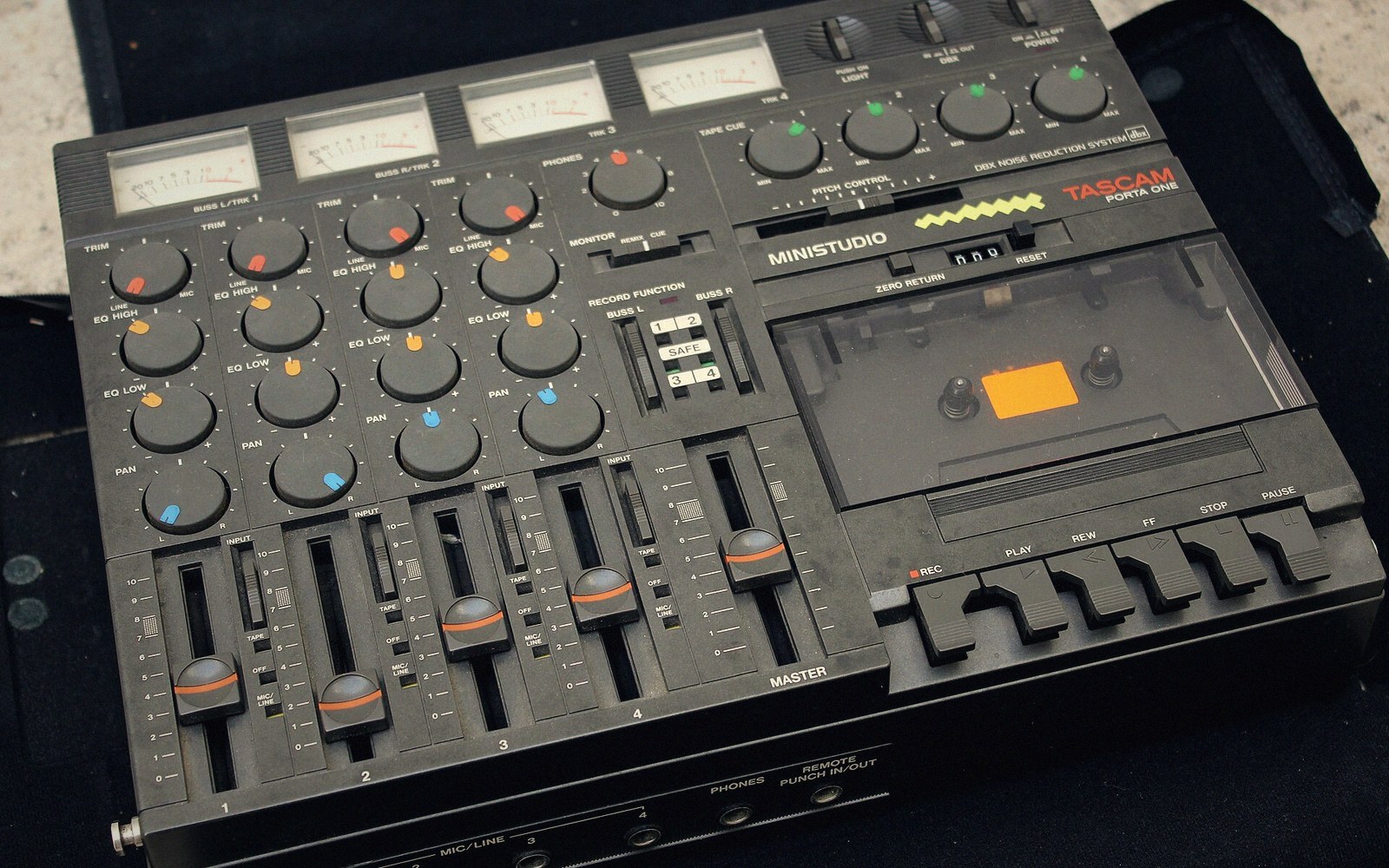
Photo: TASCAM Ministudio PortaOne - 4 track cassette tape recorder (c.1986) · Wikimedia Commons
Roland released a compact digital recreation as the TR-08 in 2017, and the company's AIRA TR-8 (2014) had preceded it with a digital model, both acknowledging that the original's faults were the point.
What the TR-808 demonstrates — and this matters for understanding the broader new wave and electronic period — is that a machine's character is not determined by its design brief. Roger Linn built the LM-1 to sound like a real drum kit and succeeded; Ikutaro Kakehashi at Roland built the 808 to do the same and did not.
Both machines became foundational, but for entirely different reasons, and to entirely different communities. The 808 is the cleaner case: it mattered because it was broken, and because enough producers had the ear and the access to hear that the break was the beauty.
Continue in The Machines
Same section, next entry
Related elsewhere in the magazine
Named in this entry
Every name above is real and appears here for documented work only. Where an origin story is contested this magazine says so rather than choosing the tidy version.