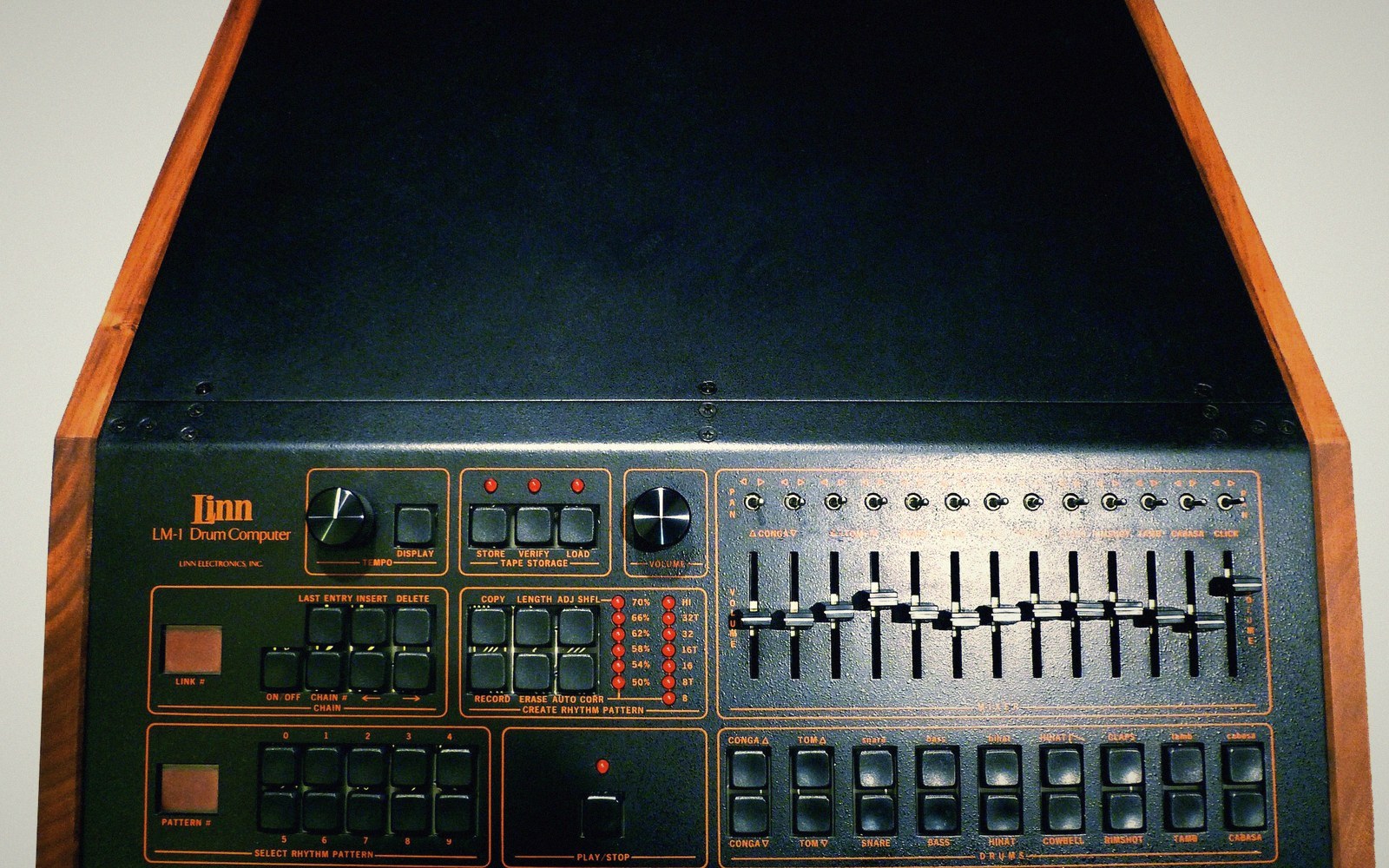
The first drum machine to use real recorded drum samples — and the reason so much early-eighties pop sounds, at the snare, exactly the same.
Before 1980, drum machines synthesized their sounds: oscillators and noise generators shaped by filters and envelopes to approximate a kick or a hi-hat. They were recognizable as artificial, and most producers used them that way — not pretending otherwise. The Linn LM-1 changed the premise entirely.
Roger Linn's machine held actual recordings of acoustic drums, pressed onto ROM chips and triggered in real time. When the snare fired, it was a snare — a specific snare, in a specific room, hit by a specific session drummer, captured once and replicated forever.
Linn Electronics released the LM-1 in 1980 at a price of roughly $5,000, which made it, by some distance, the most expensive drum machine on the market. It was not aimed at hobbyists.
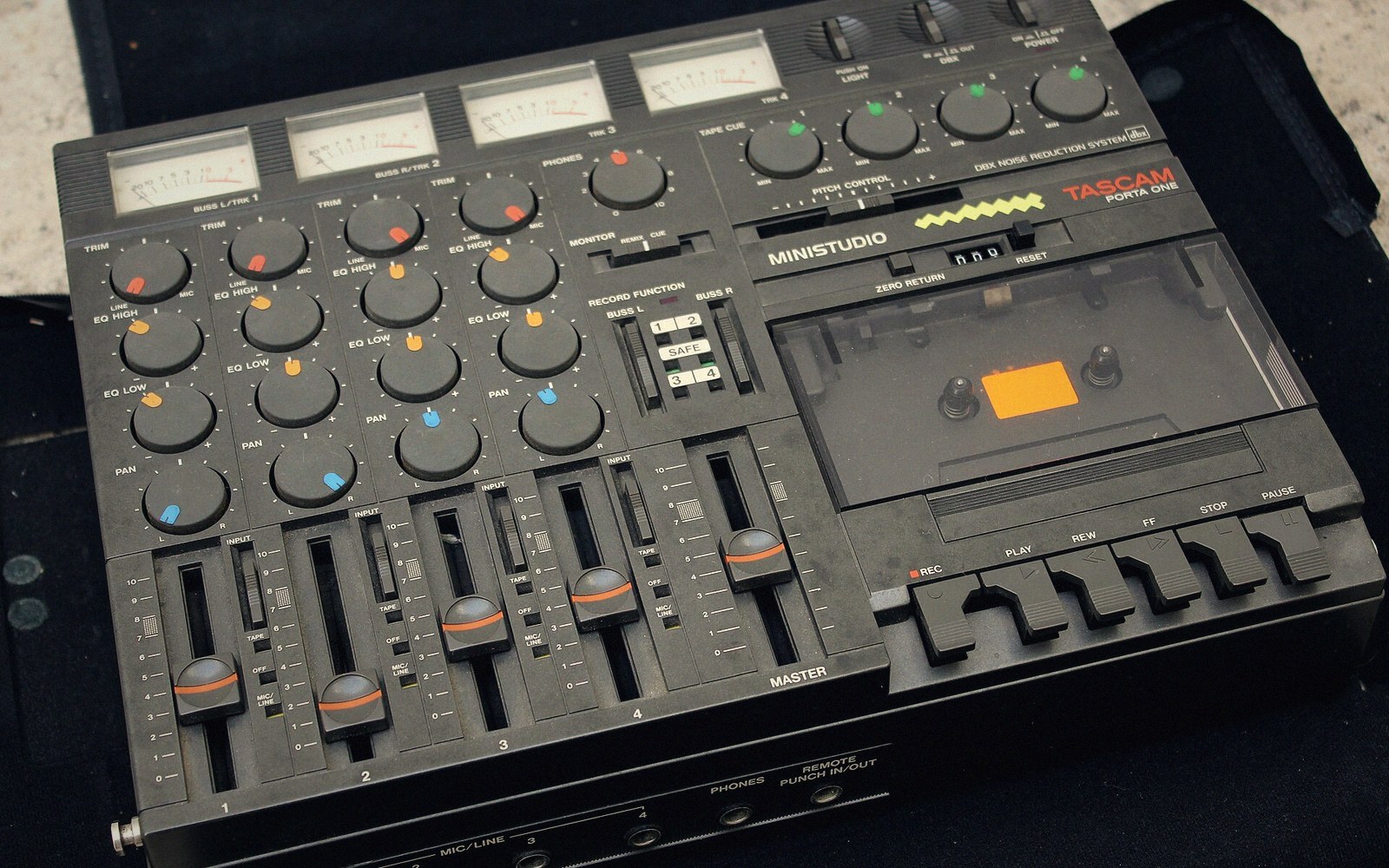
Photo: TASCAM Ministudio PortaOne - 4 track cassette tape recorder (c.1986) · Wikimedia Commons
It sold to working producers and well-funded artists, and the list of early adopters read like a who's-who of the era's pop infrastructure: Prince used one on 1999 and Purple Rain; Michael Jackson's Thriller leans on it; Gary Numan, Devo and a wide band of new wave and R&B producers ran it through sessions across Los Angeles, London and beyond.
The Sound and Its Constraints
The LM-1 carried thirteen sounds — kick, snare, hi-hat open and closed, cabasa, tambourine, three toms, conga, cowbell, claps and clave — each a short digital sample stored at a relatively low bit depth and sample rate by later standards.
The snare in particular had a character that was immediately identifiable: bright, slightly compressed, with a fast transient and a clean decay. Because every machine shipped with the same chips, every record made on an LM-1 shared that snare. There was no variation between units; the sample was fixed in ROM.
Linn did allow some pitch adjustment per voice, which meant producers could tune the kick and toms to match a track's key — a meaningful practical feature and a sign that the machine was designed by someone thinking about real sessions.
The sequencer was programmable in real time or step time, with individual voice quantisation and the ability to enter parts with intentional timing feel rather than rigid grid placement. That last point mattered: the LM-1 was designed to feel more like a drummer than a metronome, and experienced users learned to exploit the subtle humanize functions accordingly.
The machine had no MIDI — that standard did not exist when it launched. Synchronisation to tape was handled via a dedicated sync tone recorded to an outside track, which placed the LM-1 squarely in the pre-MIDI discipline of sequencer lock that dominated studio workflow until 1983. When MIDI did arrive, Linn retrofitted some units and released the successor LM-2 — the LinnDrum.
The drums could be finalized before a single other instrument was recorded, which inverted the traditional session logic of tracking live drums first and overdubbing around them.
What It Left Behind
The LM-1's influence on production was structural as well as tonal. Because the machine could be programmed precisely and then locked to multitrack tape, it let producers build arrangements around an absolutely fixed rhythmic spine — no bleed, no timing drift, no re-takes. The drums could be finalized before a single other instrument was recorded, which inverted the traditional session logic of tracking live drums first and overdubbing around them.
That rigidity fed directly into the sound of the period. The clipped, mechanical precision of early-eighties pop — the sense that everything is slotted into a grid even when it isn't — owes as much to the LM-1's workflow as to any synthesizer or studio treatment.
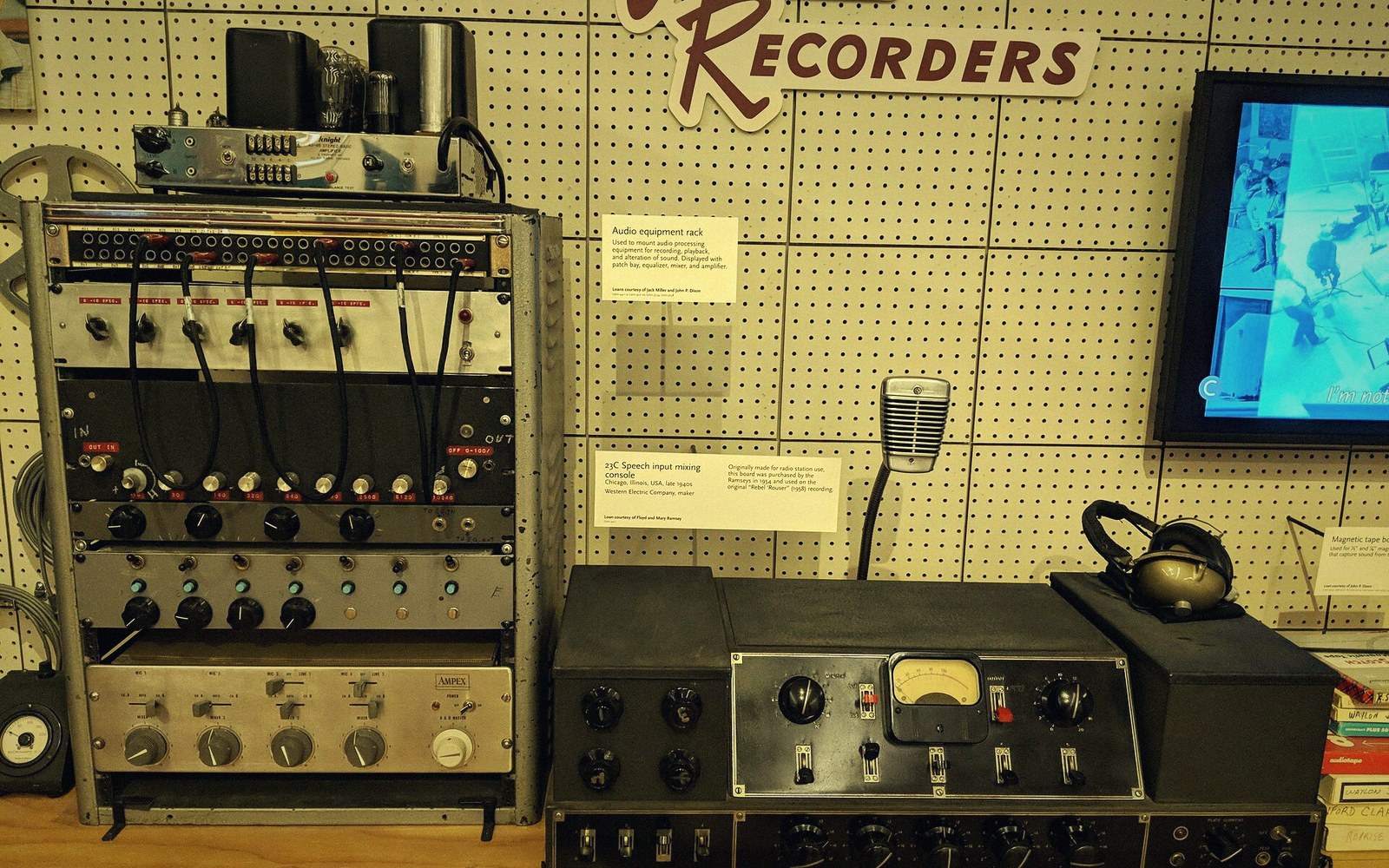
Photo: Western Electric 23C Speech input mixing console (1940s) purchased by Floyd Ramsey at Audio Recorders (studio) in 1954, & unknown recording studio rack - MIM Phoenix AZ (2017-12-04 14.04.59 by bobintraveling 140459) · Wikimedia Commons
Gated reverb, the era's other defining drum sound, was developed partly in response to working with programmed machines; the Townhouse Studio 2 experiments that Hugh Padgham helped develop were applied to live drums precisely because the LM-1 had made mechanical precision aspirational.
The LM-1 was discontinued by the mid-eighties, overtaken by cheaper machines — among them Roland's TR-808 — that offered more flexibility, and prices that didn't require a record-company advance to justify. But the snare it stamped onto the decade remains immediately audible. Put on almost any top-forty pop record from 1981 to 1984 and there it is: the same chip, the same room, the same hit.
Continue in The Machines
Same section, next entry
Related elsewhere in the magazine
Named in this entry
Every name above is real and appears here for documented work only. Where an origin story is contested this magazine says so rather than choosing the tidy version.