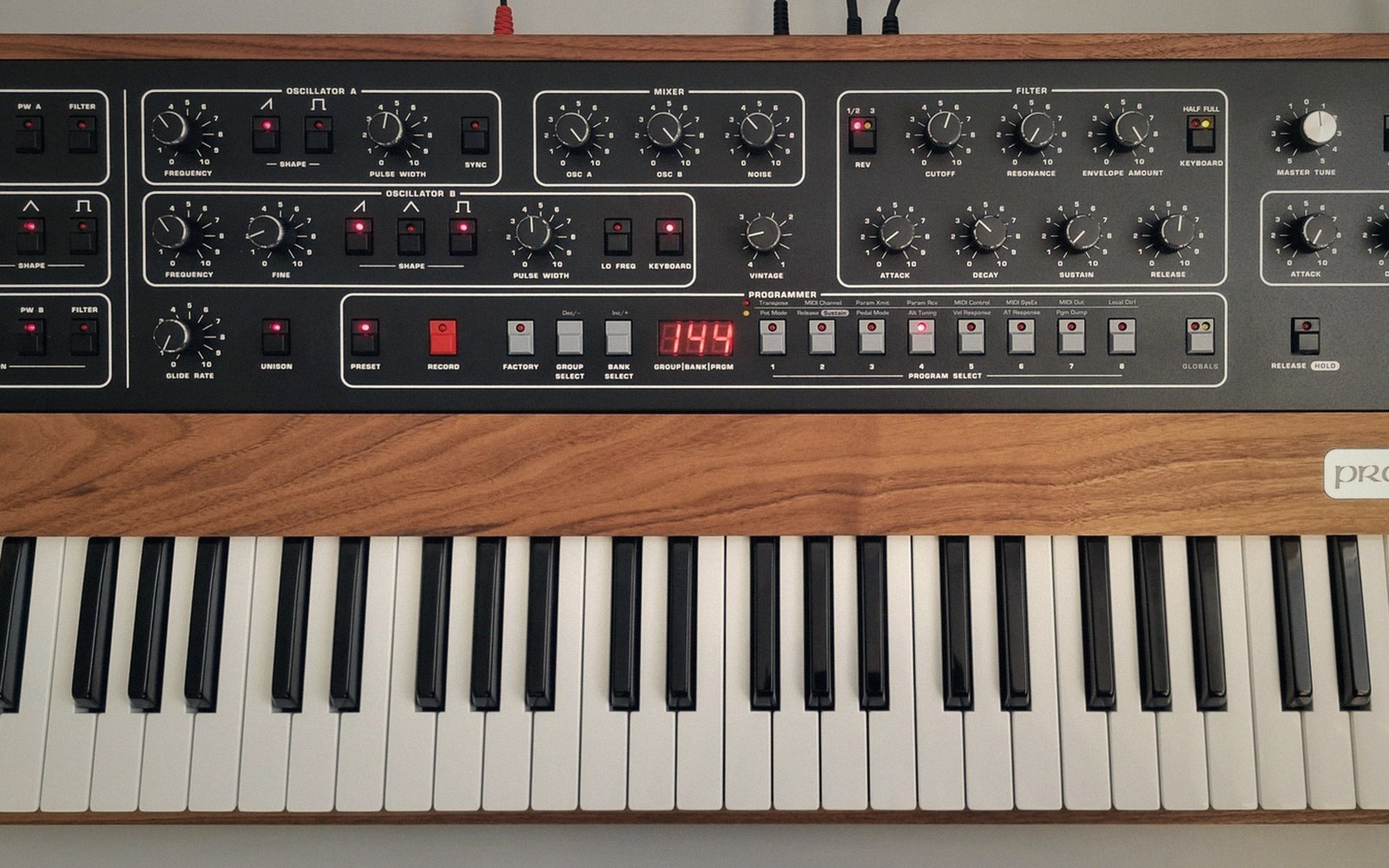
Five voices, one button — the first polysynth that remembered what it sounded like
Before 1978, owning a polyphonic synthesiser meant owning an instrument that forgot everything the moment you changed a patch. The Polymoog, the Oberheim Four-Voice, the Yamaha CS-80 — capable machines, each of them — stored nothing. Every preset either came baked into the hardware or had to be rebuilt by hand from a written parameter sheet, knob by knob, before a session. In a recording studio, where time is the expensive variable, that was a structural problem.
Dave Smith and John Bowen at Sequential Circuits in San Jose solved it with a single design decision: patch memory. The Prophet-5, introduced at the 1978 NAMM show, could store up to forty programs, each one a complete snapshot of every oscillator, filter, envelope and modulation setting across all five voices.
You pressed a button and the synth was, within the tolerance of its analog circuitry, in the same place it had been yesterday. For producers and session players, this changed the economics of synthesis entirely.
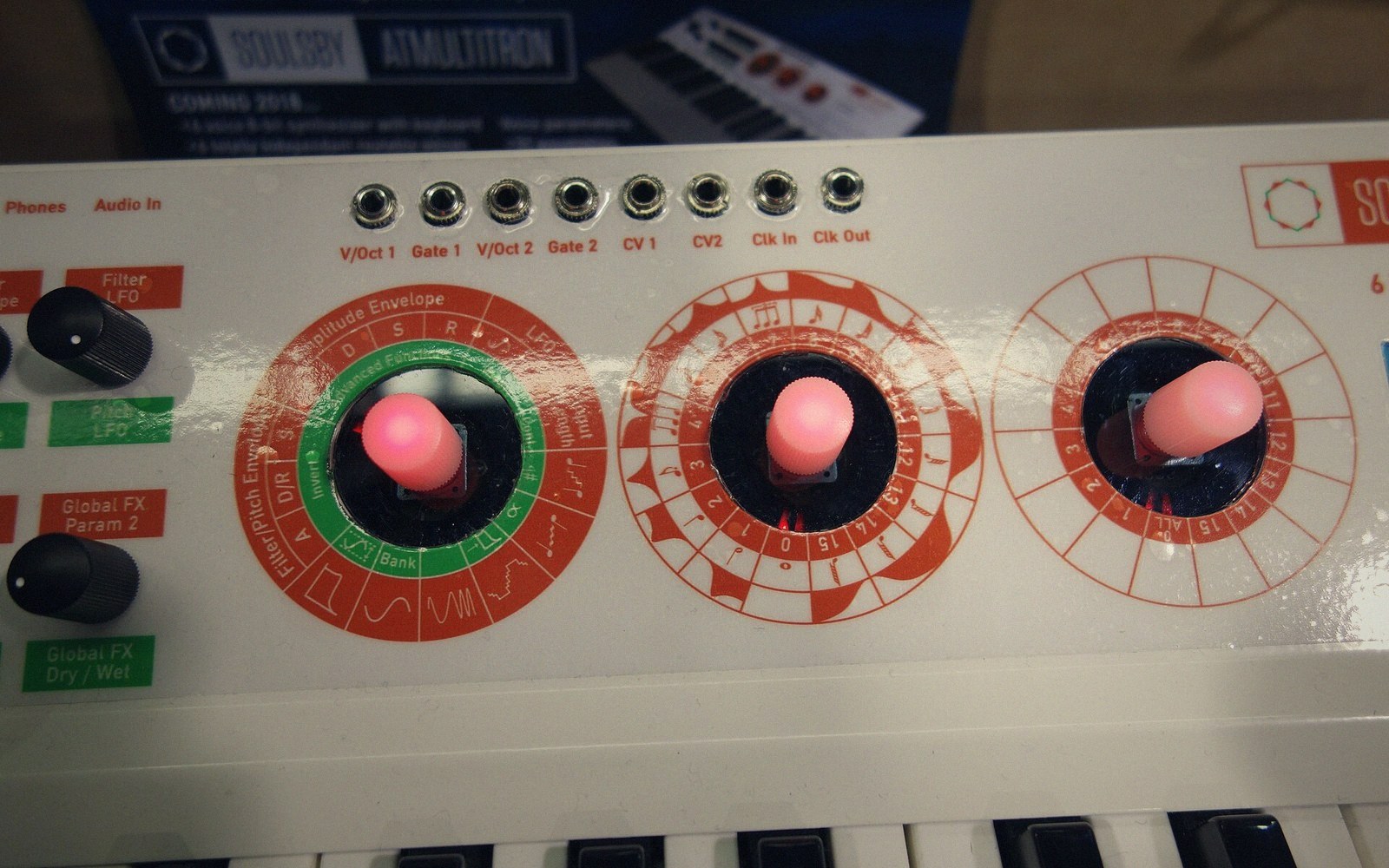
Photo: Soulsby Atmultitron - 6 Voice 8-bit Synthesizer - panel middle - 2017 NAMM Show (2017-01-21 17.39.56 by Pete Brown @ Flickr 32432577146) · Wikimedia Commons
The voice architecture itself was orthodox by later standards but generous for the time. Each of the five voices ran two voltage-controlled oscillators — both built around the same oscillator chip design — feeding a four-pole Curtis low-pass filter with resonance, then a VCA, all governed by two ADSR envelopes and a single shared LFO.
Five voices of that meant five-note chords, which covered most of what popular music actually required. The polyphony was real and independent, not the shared-resource compromise of some earlier instruments.
Three Revisions, One Reputation
Sequential built three distinct hardware revisions. The Rev 1 and Rev 2 machines, running on SSM chips, are regarded by many technicians as the warmest sounding — slightly unpredictable in voice-to-voice consistency in ways that turned out to be sonically useful.
The Rev 3, switching to Curtis chips throughout, was more stable, more easily serviced, and became the most widely manufactured. The difference between them is audible enough that studios sometimes specified which revision they wanted on a hire list, though which sounds better is a question whose answer tends to follow whoever is being asked.
Because the five voices were analog circuits rather than digital models, identical control voltages did not always produce identical pitches or timbres across all five.
Sequential addressed this with an on-board auto-tune routine — hold a key combination and the Prophet-5 would calibrate itself — but voice spread was never entirely eliminated, and in ensemble textures that slight divergence became part of the character. The shimmer on a slow string pad, the slight width on a held chord: those qualities were not programmed in. They were physics.
In the Studio
By the early 1980s the Prophet-5 was standard equipment in studios across London and New York, appearing on records from Duran Duran to Gary Numan to Peter Gabriel.
Because the five voices were analog circuits rather than digital models, identical control voltages did not always produce identical pitches or timbres across all five.
Martin Rushent, working with the Human League on Dare , used one as part of a sequencer-driven arrangement that treated synthesisers as structural components rather than decorative color — the Prophet-5's patch memory meaning a part could be recalled mid-session without rebuilding it from scratch. Trevor Horn, whose productions in the early 1980s relied on layering and precise timbre control, kept one in regular service at Sarm East and later at Sarm West.
The Prophet-5 also landed at the exact moment studios were beginning to lock sequencers and drum machines to multitrack tape — the synchronisation infrastructure that made groove-tight synthesiser arrangements possible. A machine that could hold its patch while the tape rewound and the session resumed was not a luxury; it was a prerequisite for that kind of work.
Photo: Egor Komarov / Pexels
Sequential Circuits followed the Prophet-5 with the Prophet-10 and later the Prophet-600, which added rudimentary MIDI when the standard emerged in 1983, co-developed by Dave Smith alongside Ikutaro Kakehashi of Roland.
The Prophet-5 itself predated MIDI and was retrofitted by various third-party manufacturers, with varying results. But its core contribution — the idea that a synthesiser should remember itself — was already embedded in how studios worked, and in every polysynth that came after it.
Continue in The Machines
Same section, next entry
Related elsewhere in the magazine
Named in this entry
Every name above is real and appears here for documented work only. Where an origin story is contested this magazine says so rather than choosing the tidy version.